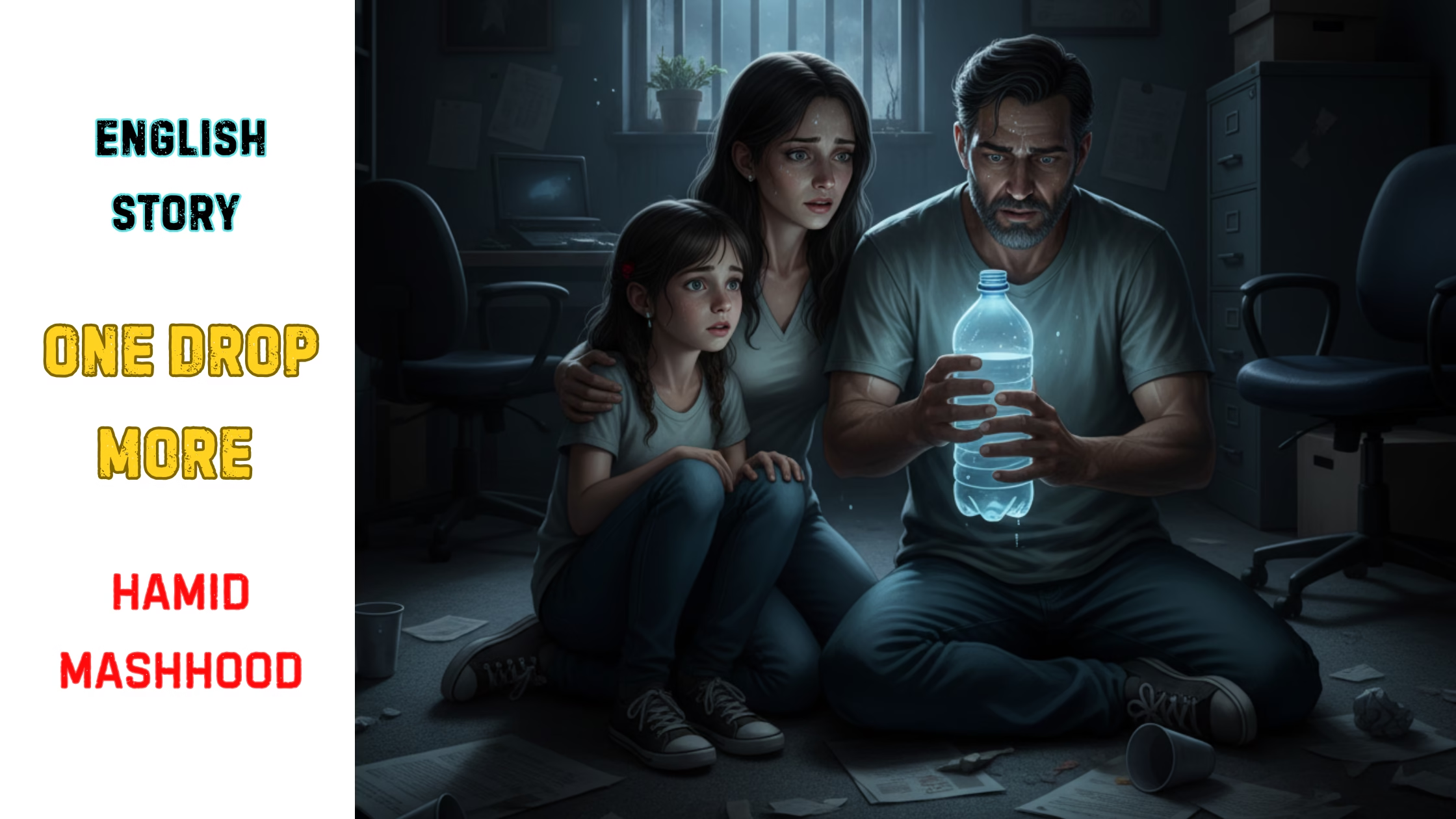
One Drop More English Story
By Hamid Mashhood
Translated By Hassaan Ahmad Awan
One Drop More by Hamid Mashhood
Irfan was pouring water out of a bottle through the open window. Because of the height, the splashes were scattering far and wide. Suddenly, Arfana scolded him:
“Irfan, you silly boy! What are you doing? You’re wasting water!”
Continuing his mischief, he replied:
“Water can’t possibly run out, oh my overly wise sister!”
“It certainly can, Mister!”
Arfana said firmly:
“This isn’t some desert; this is Karachi—on one side roars the Indus River, and on the other lies the Arabian Sea with its endless waves. Water everywhere, waves everywhere. And here you are, wasting God’s blessing.”
“Yes, yes, as if you’re the appointed guardian of God’s blessings. Shame on you, Irfan!” Arfana scolded him again.
But Irfan didn’t feel ashamed. After emptying one bottle, he began pouring out a second one. When he reached for a third, Arfana landed a solid punch on his back. In retaliation, Irfan kicked her like a mule, and a full-fledged battle began. Just then, their mother arrived. She had plenty of experience in ending such battles. Acting as a mediator, she slapped both of them twice, bringing the war to an end.
When she pulled their ears, both started defending themselves with arguments. After listening, their mother gave the verdict in Arfana’s favor and scolded Irfan harshly for wasting water. Sulking, he said:
“But you also leave the tap running in the bathroom without any reason. Isn’t that wasting water too?”
Before their mother could justify her own habit, their father, Mr. Sajid, emerged from his office room and announced:
“Well, the work is finished. Now we’ll have three days off!”
Everyone cheered at the announcement. Why wouldn’t they? They had been waiting since 7:30 p.m. for Mr. Sajid to emerge from his piles of office files so they could go out together. Immediately, suggestions for recreational spots started pouring in.
Arfana suggested:
“Clifton.”
Irfan suggested:
“Hawks Bay.”
Arfana countered:
“Swat.”
Irfan argued:
“Why not Kaghan?”
And so began another verbal quarrel, which couldn’t turn physical because of their parents’ presence. Mrs. Sajid intervened:
“First, let’s have some dinner. Remember, you promised us a heavy feast.”
“Yes, yes, I remember, dear. We’ll fulfill the promise right away. Irfan, shut the window and latch it.” Mr. Sajid walked toward the main office door, which the office boy had locked after the family arrived. Irfan closed the window, and the three of them followed their father to the door.
When Mr. Sajid tried to unlock the main office door, he failed. It was fitted with a strong internal lock that required a key from both sides. He kept turning the key in the hole, but the lock wouldn’t open. Locks come in many kinds: some open with a single twist, some with two or three, and some require turning the key twice in the opposite direction. But in his stress, Mr. Sajid had forgotten all this and kept twisting in one direction. Kneeling on the floor, he tried again.
Mrs. Sajid remarked:
“You’ve worked in this office for ten years, but it seems you’re opening the lock for the first time.”
He replied:
“The office door stays open all day. Only at closing time does the office boy lock it. That’s his job, not mine.”
Irfan jumped in:
“Let me try. There’s a special technique to unlock these!”
Before he could finish, Mr. Sajid forced the key too hard. The brass duplicate key broke inside the hole. The larger part was stuck inside, while the smaller piece remained in his fingers. His face turned pale.
“What will happen now?” Mrs. Sajid asked anxiously.
Mr. Sajid stood up and said:
“Now we’ll have to stay locked inside for three days.”
Mrs. Sajid protested:
“No, that can’t be. Call one of your colleagues to open the door.”
He replied:
“The office telephone is out of order.”
“And your mobile?”
“The balance expired today. I can only receive calls, not make them.”
A dreadful silence filled the room. Then Mr. Sajid, in a faint hope, shouted through the door, calling out neighboring offices by name. No response. The floor was entirely offices, all closed for the night. It was already 9 p.m.
To make matters worse, there was a local holiday, a national holiday, and the weekend—all three in a row. This coincidence turned into their nightmare, trapping them inside. Arfana’s eyes welled up, and Irfan forgot all his mischief.
“Dad, let’s break the lock!” Irfan suggested.
“With what?” Mr. Sajid replied. “In my room, there are only papers, pens, files, and an empty glass. In the bathroom, there’s soap and a bucket of water. Which of these will you use to break a lock?”
They moved back to the lounge and sat gloomily on sofas. Mr. Sajid, feeling hot, switched on the AC. Irfan leaned out of the window, shouting at the top of his lungs, but being on the twelfth floor, his cries dissolved into thin air. Exhausted, he reached for water. On the table were the two empty bottles he had proudly emptied earlier. He picked up the third one, but Mr. Sajid warned:
“Irfan, don’t drink. That’s the only bottle left, and we have three days and four nights ahead.”
“No other water?” Irfan asked.
“There’s the water cooler over there—bone dry.”
“Maybe water in the bathroom?”
“That’s brackish groundwater from the coast—too salty to drink.”
Hopelessly, Irfan put the bottle back. Suddenly, there was a thud near the door, and the entire office went dark. Mr. Sajid explained:
“The wiring’s burnt out. Now we can’t even run the motor pump to draw brackish water.”
This was disastrous. They were in Karachi but felt like they were stranded in a desert—heat, darkness, and thirst. Somehow, they survived the night. In the morning, each had just a sip of water for breakfast, thanking God nonetheless.
Hunger was bearable, but thirst was unbearable. Irfan regretted wasting those 2.5-liter bottles. Only half a liter remained for four people. By the second day, even the bathroom water ran out.
That evening, Irfan scribbled messages on scraps of paper and threw them out the window, but who would notice? The notes drifted away. At night, under faint moonlight through the window, Mr. Sajid carefully divided the little water left. Irfan pleaded:
“Dad, give me some more.”
“No, not possible.”
“But my throat is parched! It’s been twelve hours since my last sip.”
“Sorry, son, it’s helplessness.”
“Just a little more… please.”
“No.”
“One drop… just one drop.”
“Drop by drop makes an ocean, and our ocean is dangerously small. Sorry.”
Now Irfan understood the value of God’s blessing. He begged for every drop, thirsting for every bead of water.
How they endured those three days and nights is beyond words. Morning and evening, they survived on tiny sips—barely moistening their throats. Each day felt like a year. When the office finally reopened, they were neither unconscious nor conscious—just trapped in between.
They couldn’t speak, only mumble. They were rushed to the hospital, where they were put on glucose drips all day.
Since then, Irfan no longer throws away water, nor does Mrs. Sajid leave taps running while cooking.